The Unbearable Lightness of Being by Milan Kundera
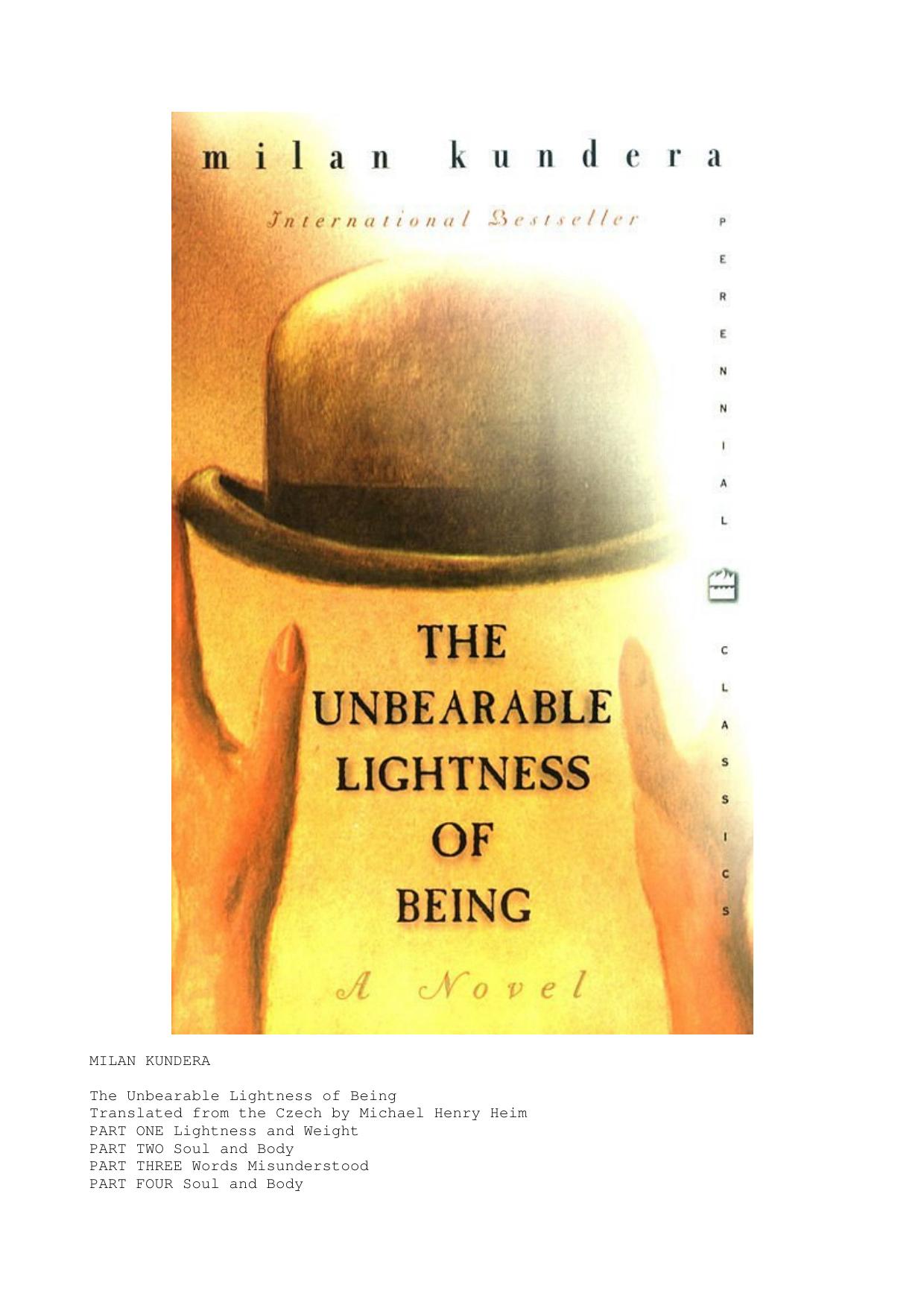
Author:Milan Kundera
Language: eng
Format: mobi, epub, azw3, pdf
ISBN: 9780061148521
Published: 1984-01-30T00:00:00+00:00
PART FIVE
Lightness and Weight
1
When Tereza unexpectedly came to visit Tomas in Prague, he made love to her, as I pointed out in Part One, that very day, or rather, that very hour, but suddenly thereafter she became feverish. As she lay in his bed and he stood over her, he had the irrepressible feeling that she was a child who had been put in a bulrush basket and sent downstream to him.
The image of the abandoned child had consequently become dear to him, and he often reflected on the ancient myths in which it occurred. It was apparently with this in mind that he picked up a translation of Sophocles' Oedipus.
The story of Oedipus is well known: Abandoned as an infant, he was taken to King Polybus, who raised him. One day, when he had grown into a youth, he came upon a dignitary riding along a mountain path. A quarrel arose, and Oedipus killed the dignitary. Later he became the husband of Queen Jocasta and ruler of Thebes. Little did he know that the man he had killed in the mountains was his father and the woman with whom he slept his mother. In the meantime, fate visited a plague on his subjects and tortured them with great pestilences. When Oedipus realized that he himself was the cause of their suffering, he put out his own eyes and wandered blind away from Thebes.
2
Anyone who thinks that the Communist regimes of Central Europe are exclusively the work of criminals is overlooking a basic truth: the criminal regimes were made not by criminals but by enthusiasts convinced they had discovered the only road to paradise. They defended that road so valiantly that they were forced to execute many people. Later it became clear that there was no paradise, that the enthusiasts were therefore murderers.
Then everyone took to shouting at the Communists: You're the ones responsible for our country's misfortunes (it had grown poor and desolate), for its loss of independence (it had fallen into the hands of the Russians), for its judicial murders!
And the accused responded: We didn't know! We were deceived! We were true believers! Deep in our hearts we are innocent!
In the end, the dispute narrowed down to a single question: Did they really not know or were they merely making believe?
Tomas followed the dispute closely (as did his ten million fellow Czechs) and was of the opinion that while there had definitely been Communists who were not completely unaware of the atrocities (they could not have been ignorant of the horrors that had been perpetrated and were still being perpetrated in postrevolutionary Russia), it was probable that the majority of the Communists had not in fact known of them.
But, he said to himself, whether they knew or didn't know is not the main issue; the main issue is whether a man is innocent because he didn't know. Is a fool on the throne relieved of all responsibility merely because he is a fool?
Let us concede that a Czech
Download
The Unbearable Lightness of Being by Milan Kundera.epub
The Unbearable Lightness of Being by Milan Kundera.azw3
The Unbearable Lightness of Being by Milan Kundera.pdf
This site does not store any files on its server. We only index and link to content provided by other sites. Please contact the content providers to delete copyright contents if any and email us, we'll remove relevant links or contents immediately.
Beautiful Disaster by McGuire Jamie(25304)
Trainspotting by Irvine Welsh(21606)
Call Me by Your Name by André Aciman(20462)
The Secret History by Donna Tartt(18993)
All the Missing Girls by Megan Miranda(15879)
Cat's cradle by Kurt Vonnegut(15293)
Pimp by Iceberg Slim(14461)
Norse Mythology by Gaiman Neil(13312)
The Tidewater Tales by John Barth(12639)
4 3 2 1: A Novel by Paul Auster(12352)
Scorched Eggs by Childs Laura(11338)
The Break by Marian Keyes(9344)
The remains of the day by Kazuo Ishiguro(8943)
Adultolescence by Gabbie Hanna(8900)
Never let me go by Kazuo Ishiguro(8844)
Where the Crawdads Sing by Delia Owens(8576)
All the Light We Cannot See: A Novel by Anthony Doerr(8471)
A Man Called Ove: A Novel by Fredrik Backman(8413)
Circe by Madeline Miller(8109)
